INRODUCTION
My father, Dr John Pringle, PhD Wits, was very much a man of the twentieth century, having spanned the years from 1910 to 2002. He was a biologist, a historian and a leader in his many fields of interest. He was also a very devoted family man and was anxious that his children, grandchildren and all present and future members of our extended family should be able to read a personal family story of those fascinating times.
After retirement in 1975, John embarked on the massive task of researching and writing a history of wildlife conservation in South Africa. This was published in 1982 by T.V. Bulpin and Books of Africa (Pty) Ltd., under the title The Conservationists and the Killers’
That done, he finally he had time to tackle the long story of the family history. He sat down at his desk, armed with his fountain pen, bottles of ink and glue, plenty of paper, piles of documents and photographs and, most importantly, his own excellent memories of days gone by. These original journals, written, longhand, in the last days of the twentieth century and bound by John himself, gradually took shape and are now safely held by my brother Robert John Pringle and myself.
Long after Dad passed away, Rob and I, having both eventually retired from work, were able to embark on the task of typing and editing the texts and copying the photos and documents into their correct positions. We finally completed the first four volumes. I then passed printed copies of Volume 1: ‘The Farmers – Dapple and Poppie’ to John’s grandchildren who found them enormously interesting. They suggested that all volumes should be placed on the Internet. The task was given our eldest grandson, Roland Gerron Elferink.
In addition to the extended family, all volumes (listed at the end of Volume 4) should be of interest to museum and scientific communities, also to historians and historical societies.
On the advice of the archivist at William Curren library at Wits University I have decided that that the original bound volumes, currently in my care, will in later years remain in the family, starting with Roland. It will then be his responsibility to pass them on to a suitable family member of the next generation. The other originals, which are currently in my brother’s library will eventually be in the care of the 1820 Settler Memorial in Grahamstown.
Copyright for all of them will be with my brother Robert John Pringle and myself and our immediate descendants until 2052 which will be fifty years after our father, the author, passed away.
Margaret Elferink (Pringle)
Saturday, May 06, 2023

Sunday, November 07, 2021
"I'm offended"
The right to "Freedom of Speech" is not an unfettered right; one can't stray in to the territory of "Hate Speech" and get away with it by appealing to one's right to "Free Speech" but there are situations where freedom of speech crosses some undefined boundary where the speech may be offensive albeit not in the domain of hate speech.
I might be making a generalization but I think that I am on pretty safe ground to say that we have all been offended at some point in our lives by what others' have said or done. To go on the offensive is to attack someone or something and to take offense is to feel that one is being attacked for some reason. It seems to me that we take offence in at least two different senses; the one is that something is perceived as a personal offense and the other where we take vicarious offense i.e where we ourselves are not the target but we empathetically take offense on other's behalf. I am of the view that taking offense is an intuitive indicator that something isn't right in the world and that this can or should serve as motivation to correct whatever is wrong so I think that "offense" is an important barometer that we should take note of but like many good things, it can be misunderstood or even abused.
Offense isn't an argument, it is an emotional reaction to a situation that is experienced. In some cases the emotional reaction can be justified by reasonable arguments whereas at other times, I think, the reaction is unjustifiable. The right to "offense" is similar to the right to "freedom of speech" where it is not an unfettered right but drawing the boundary between justified and unjustified "offense" taken, like that of "freedom of speech" uttered, is a difficult line to draw. It is like "offended" and "freedom of speech" are opposites but somewhat related where "offended" is a reaction to the action of "speech".
People take offense, ideas aren't capable of taking offense. So for example if someone was to say that "The theory of evolution is stupid" it is never the case that "The theory of evolution" takes offense; if any offense is taken it may be by someone for whom the "Theory of evolution" is true and perceives the statement "The theory of evolution is stupid" as intimating that they themselves are "stupid" for holding that position. This, for me, is a mis-fire of vicarious offense where we confuse ideas and people thinking that ideas, like people, can take offense. In this particular example the statement itself is an issue which highlights how we have a tendency to anthropomorphize many things which I think is the key to understanding what is going on. The "Theory of evolution" can't be "stupid" nor "clever" because those adjectives are used to describe degrees of intelligence which requires the ability, in some form, to think.
Could there be a general rule as to when it is justified to take offense as well as when it is unjustified? When a viewpoint is expressed it seems too easy to claim that "I'm offended" by what has been said and thereby effectively censoring or limiting "freedom of speech" behind a wall of, possibly sincere, but faux offense. One should not be limited in what one is able to say simply because someone else may take offense. Since offense taken can often be expressed as anger I think that working out whether an offense taken and the ensuing anger is justified or not is an important topic for discussion.
Breaking offense down into a few sub-categories where offense is taken to try to tease out when taking offense is justified or not. Is offense being taken :
1.1 Something that a person cannot change e.g. race, sex, gender, age, height, intelligence in which case the taking of offense is justified and we have racism, sexism, ableism and all the other ism's that describe discrimination about something that we are actually unable to change.
1.2 Something that a person has chosen e.g. political, religious or other views. If one has chosen a viewpoint to hold then one has some kind of responsibility for holding said viewpoint so if someone else is exercising their right to freedom of speech and without straying into 1.1 and one feels offended, it is time to examine why one actually holds these viewpoints. Being offended is a barometer and sometimes that barometer is saying that possibly your own viewpoint is wrong rather then the argument put forward by the interlocutor. Because we never like to be wrong we all tend to fall back on offense as the defense and as Archbishop Desmond Tutu said when quoting his father who apparently said, "Don't get angry, improve your argument!".
2. Vicariously. Is the "other" a1.2 Something that a person has chosen e.g. political, religious or other views. If one has chosen a viewpoint to hold then one has some kind of responsibility for holding said viewpoint so if someone else is exercising their right to freedom of speech and without straying into 1.1 and one feels offended, it is time to examine why one actually holds these viewpoints. Being offended is a barometer and sometimes that barometer is saying that possibly your own viewpoint is wrong rather then the argument put forward by the interlocutor. Because we never like to be wrong we all tend to fall back on offense as the defense and as Archbishop Desmond Tutu said when quoting his father who apparently said, "Don't get angry, improve your argument!".
2.1 Person - See Personally in 1. above to work out whether it is justified offense or not but this is where I think that the taking of offense on behalf of others can be an important tool in moving society as a whole forward.
2.2 Concepts, ideology or anything other than a person. This, I think, is mis-firing vicarious offense mistakenly taken up on behalf of something which cannot take offense. In this case it is likely that one is actually in the domain of 1.2 and the barometer is indicating that maybe one should improve one's own arguments rather then being offended by others' arguments. An example of this would be "Blasphemy" where someone is offended on behalf of a god, which by definition, isn't a person so what is happening is that one is taking offense simply because someone else holds a viewpoint different to one's own.
2.2 Concepts, ideology or anything other than a person. This, I think, is mis-firing vicarious offense mistakenly taken up on behalf of something which cannot take offense. In this case it is likely that one is actually in the domain of 1.2 and the barometer is indicating that maybe one should improve one's own arguments rather then being offended by others' arguments. An example of this would be "Blasphemy" where someone is offended on behalf of a god, which by definition, isn't a person so what is happening is that one is taking offense simply because someone else holds a viewpoint different to one's own.
Update : The term "vicarious offense" was suggested by P.K and I have made use of it.
Thursday, September 16, 2021
Ndzopfuri to Pafuri Picnic Site. (Approximately 60km)
The last morning's alarm clock was provided by the francolins; I quite like these natural alarm clocks and they are infinitely superior to the hadedah calls that we get at home.
Packing up was quick and efficient now that we have all got our processes together and making that extra pot of coffee and putting it in a flask for consumption mid or late morning is definitely something we will be doing in the future. Having a good cup of coffee in the middle of nowhere is a great experience, well, at least I love it.
We were all ready to go and we both hopped into the car only to realize that the keys were missing; I though Caron had them and she thought I had them. Turns out the tent had them so we had to unpack, unroll and vroetel around in the tent looking for the pocket they would have been in, re-pack the tent while everyone else waited patiently for us to finish. Even with that abortive start we weren't that late away from the campsite.
Along the drive today we saw some "Kuif Kop Tarentaal" a.k.a crested guinea fowl which was another first for us but somehow 'kuif kop' just describes the bird better than the bland 'crested'.

Morning coffee was at crooks corner which is named for the scoundrels
that used to congregate here at the confluence of three countries so
irrespective of which countries law enforcement wanted to catch them
they could easily escape into a neighboring country and be out of
reach of the long arm. As we have seen over the whole trip, as soon as there is water
which, in this case is in the Levuvhu river, the vegetation thrives
which attracts the game which, in turn attracts the tourists. After
being all on our own in the park for the last 5 days it was a bit of an
adjustment now having to 'share' everything with arbitrary other people.

After
a couple of days of mishap free days we had to have one for the road.
On the very short drive from Crooks corner to Pafuri picnic spot we were
driving in convoy five in a line and Tony, right in the midle of the
convoy, had a head on collision with another car. It wasn't too serious
at least from Tony's point of view, Landcruiser vs Hyundai ... there is
only one winner and it wasn't the Hyundai. Nobody injured and it all
happened at low speed but one wonders what the woman was doing driving
around a blind corner without stopping and right into the middle of a convoy
of vehicles. Tony was rather calm about it all and even though it all
happened at low speeds and nobody was injured, it is still an accident
and that always gets the adrenaline pumping. They swapped numbers and
five minutes later we were at the Pafuri picnic spot where we all went
our separate ways.
 |
| Photo courtesy of Amanda |
The apprehensions of our first day have been
allayed, it is not true that in every four-ball there is an arsehole.
Maybe we were just lucky but all the people on the trip turned out to be
really great people and their presence enhanced the trip rather than
diminished the experience so I think in future we won't be quite so
reluctant to participate in ventures where we don't know anyone.
Theresa
gave a little farewell speech thanking us all for not talking about
COVID nor politics and generally being pleasant, normal people and ended
with a quote by memory from the bible which was very appropriate for
the circumstances and I think that everyone, irrespective of one's own
beliefs or lack of them, appreciated the sentiments expressed.
So
trip done and I would recommend it to people and especially to people
that haven't done overlanding, as opposed to a game drive, before as it
gives a real taste of what it is like in a relatively benign environment
with readily accessible outside help should one need it.
Wednesday, September 15, 2021
Shilowa to Ndzopfuri via Shingwedzi Rest Camp. (Approximately 90km)
We woke up to the baboons arguing about something, not the most peacefull way to start the day and I definitely prefer the Pearl Spotted Owls but I think Caron prefers the baboons for some unfathomable reason. We are starting to really get into the swing of things and everyone was ready to roll well before 07:00 so we left spot on 07:00. I was very sorry to leave Shilowa campsite, I could really see myself spending a few days here under the shady trees in the bend of the dry river with nice hills nearby to climb.

Today was the day we started to see Baobabs which are a truly
iconic Southern African tree and the first one we stopped at was about
300 years old and it turns out that the elephants really like to eat the
tree and in the photograph below the big hole into which Tony and
Cheryl have climbed is the result of the elephants. Some of the Baobabs
that we saw had been gnawed all the way around which for most trees
would have been a death sentence but the Baobab is special in that kind
of way.
[
 |
| Elephant damage. Photo courtesy of Caron. |
There had been a family living at this particular trees location up until about 1960 even though the park was proclaimed in 1926 before they were evicted during the Apartheid era so I am sure that this forms part of a land claim by either themselves or their descendants.
After yesterdays tyre and the previous days caravan sage I was wondering what was in store for us today but, thankfully, today there were no untoward incidents and the driving was really easy. Mostly sandy tracks with the occasional steep rocky ascent or descent.
 |
| Photo courtesy of Caron |
The next Baobab that we stopped at was
absolutely huge, it is estimated at about 1000years old but it was on
the Mozambican side of the fence with a very enticing hole in the fence
just where it needs to be. Nobody dared to actually go over because,
apparently according to Edward, the Mozambican authorities have got wind
of tourists crossing the border illegally and have been known to lie in
wait for the unwary tourst and arresting them for illegal entry. It
doesn't sound like anyone actually went to jail for this but it does
sound like it was an expensive exercise to avoid any jail time. It all
looked perfectly peaceful and quiet on the other side but one never
knows; anyway we were happy to just take our photo's from the South
African side of the fence.

Shortly after the Baobab we bumped
into an armed anti-poaching patrol looking for tracks of people entering
from mozambique to poach Rhino, Elephant or Lions for profit or
anything else just to eat. One has to feel some kind of sympathy for
those poaching to survive but for those engaging in it for profit, not
so much. A couple of days ago we had come across what looks like a
heavy rubber blanket just left in the middle of the road and apparently
what the rangers do is to hook that up to the back of a bakkie and drive
the border road effectively sweeping it which makes any tracks of
poachers really stand out and once they have the tracks they can find
the poachers. Caron takes quite a hard line against poachers which is
apparently shared by the anti-poaching patrol. We thanked them for
their service and shared some droe-wors with them which I am sure they
enjoyed later on.
After that, it was miles and miles of Mopane
which is apparently not Tony's favourite environment. I do have to
agree as it does get a little monotonous but driving from south to north
we can see the vegetation and the animals changing along with the
vegetation. For instance, grazers most stick to the soet (sweet) veld
whereas the browsers or those that both graze and browse wander over the
suur (sour) veld as well so the areas of suur veld appear to have fewer
animals around. Of course proximity to water is also a significant
determining factor as to how many animals one sees so there are long
stretches when one really doesn't see much wildlife due to the grazing
being poor and far away from water sources.
We had a break at
Shingwedzi Rest camp which is fine if looking a little tired and had a
great sighting of a Bateleur on the ground which, it turns out, isn't an
eagle. Seeing her on the ground is quite unusual and it is surprising
how powerfully built she is. We also say some yellow-billed storks
which was a first for us and with the water pools still in the
Shingwedzi river there was loads of game in the area. In quite a short
space of time we say Elephants, buffalo, crocodiles, nyalas, kudu and of
course, the ubiquitous impala.

Arrived at our final camp at
around 15:30 which was great as it meant that we had some time to relax
in the shade of the trees which weren't quite as nice as the one's we
left behind at Shilowa but shady enough. It was a really hot afternoon
and my temperature gauge in the car briefly touched 47 deg. centigrade
but I have a feeling that it is over-reading by at least a few degrees
as nobody else saw 47 deg; they were all down in the low 40's.
 |
| Photo courtesy of Caron. |
For
supper we had pasta while everyone else braai'd and this sharing a fire
and just grabbing a shovel full of coals when one needs them really
works well. With it being the last night everyone brought out the
delicacies that they had been saving like the "Salmon Roulade" shared by
Therese and Pieter which went down extraordinarily well. We ended up
in the middle of the group around the camp fire and had a very pleasant
conversation with Amanda and Jonathan who is now really starting to come
out of his shell. While we were busy snacking on all the delicacies we
were invaded by the fancolins who are VERY habituated wanting their
fair share of the food.
The campsite was unusual in that it had
what Edward referred to as stingless bees which no anti-mozzie/fly
ointment or prevention has any effect on. The only known method is to
take a branch with some leaves and fan one's self which feels a bit 19th
century so there we were with most people fanning away furiously but
for some reason they just didn't bother me.
After a nice warm
shower we were off to bed a little worried that after the very hot day,
the night may be uncomfortably warm as well.
 |
| Nyala. Photo courtesy of Amanda |
Tuesday, September 14, 2021
Pumbe to Shilowa via Olifants Rest Camp. (Approximately 90km)
Alarm call today courtesy of the Pearl Spotted Owl which started calling at 05:10 and just would not stop. Normally Caron loves the calls of the morning, but not today. Today, if Caron could have found the Pearl Spotted Owl it would have been fricasseed owl. After the long day yesterday everyone was looking forward to a easier day and, hopefully, no breakdowns nor punctures.
 |
| Easy driving. Photo courtesy of Amanda |
We are starting to get into the swing of things and everyone was ready
to go at 06:30 and the day was very easy driving even thought there were
plenty of occasions when we used low range but it was more for comfort
rather than because the conditions mandated it. As we drove we could
see the vegetation slowly changing and our first stop was a dry pan
which is home to two species of fish which is pretty hard to believe
given that the pan looks like below. The species are called Killi and
Lung fish and are able to bury themselves in the mud and depress their
metabolism to such a degree that they can last years under the sun baked
mud.


Arriving at Olifants rest camp there was a
rush for the showers but we made for the restaurant and had a cup of
coffee which I wrote up this diary. It's a funny thing keeping a
travelogue because it takes about 30 minutes per day but to find 30
minutes where one can just be on one's own and quiet and not too tired
like at the end of a hard day is quite difficult so I snatch it when I
can. It is one thing that thinking back on the trip would be really
nice; about an hour each day when one isn't driving or pitching/striking
camp or making food and one can just sit and be quiet in the bush would
really be great. Returning from my cup of coffee I found that I had
been parked in and had to go and find who the responsible party was and I
ended up getting the restaurant staff to go from table to table; I
thought they would have had a PA system and done it over that but it was
a table to table affair. The miscreant was a little indignant with
me but I was less than cheerful that he was that inconsiderate.
 |
| View from the restaurant. Photo courtesy of Caron. |
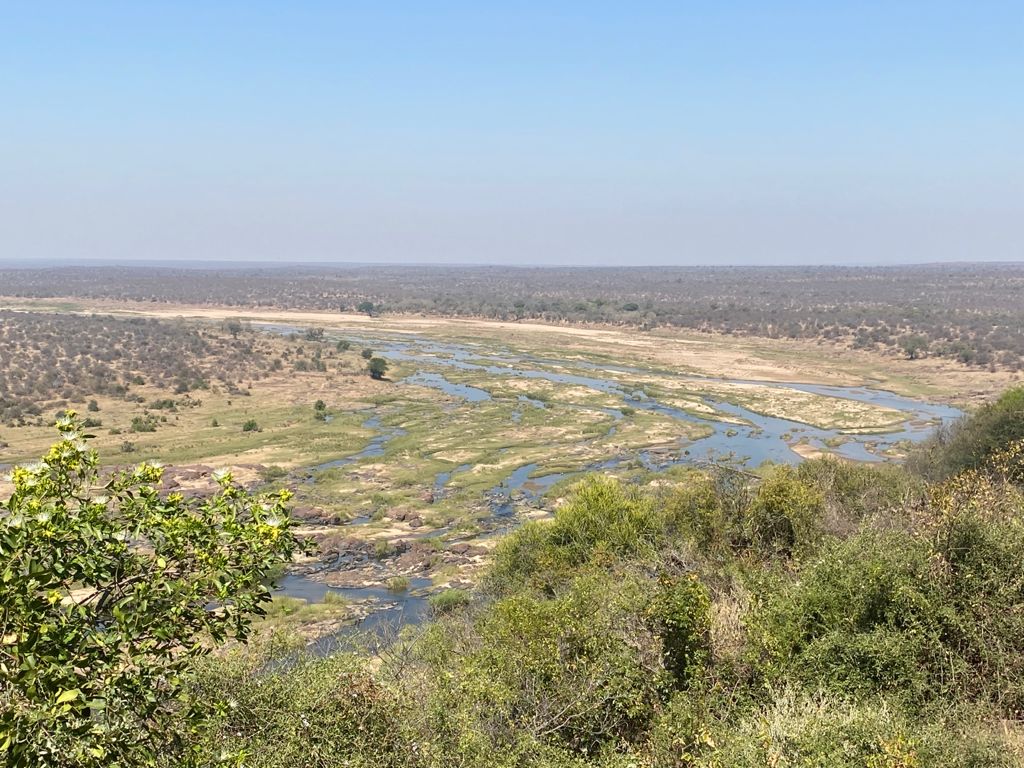
The view from the restaurant deck is definitely a must do in Olifants Rest Camp; it's spectacular! After everyone other than us had showered and filled up with water and fuel and air we drove a short while and stopped in the middle of the low water bridge over the Letaba river which was nice but rather hot. I think that Edward likes stopping there because there is lots of space to see any elephants, buffalo or crocodiles that may be lurking around. Pieter put up his bat-wing wrap around awning which works really well except when there is a strong gust of wind so he ended up hanging onto the ends of the supports to prevent it flying away.
 | |
| Letaba river for lunch. Photo courtesy of Caron. |
The thermometer in my car hit 43 deg. C this afternoon which is warm but I thought quite bearable although that temperature overnight would have me thinking differently. The fences in this section have been taken down leaving only the railway tracks which were sunk vertically into the ground to indicate where the border is. If they ever need to put up the fence again they will at least have the major posts still there and only have to re-lay the cable and wire mesh.

The last stop we had before arriving in the Shilowa campsite was on top of a small set of hills from which one could see far into Mozambique which looks exactly the same as Kruger; it really feels like one is in the monstrous uninhabited country rather than in a national park. Shilowa campsite is magnificent and I could easly spend a day or two here under the big trees just relaxing; reading and enjoying the peace and quiet. Supper was the usual braai and since there were so many braai designs on display it seems that the perfect design has yet to be found. I made use of Pieters rather then unpacking my own and it worked really well with a very small number of coals so I may have to think again about which braai to use in the future but I think I may stick with the draai-braai for a while at least. I had put our chairs on the one side of the fire and everyone else ended up on the other side and it felt a little like we were the show for the evening; it did make communication over the whole fireplace a little awkward but that is just how it goes sometimes.
Nice if VERY warm shower before bed at 20:30; fell fast asleep almost immediately.
The toilets in all the camps are some kind of composting toilet and, except for one, are relatively odorless and it is always nice to have real porcelain deep in the bush and it sure beats digging a hole.

Monday, September 13, 2021
Mitini to Pumbe via no Rest Camp. (Approximately 120km)
We had been warned that today was going to be a very long day so everyone was up early, courtesy of the fish eagles calling, and I think that by 06:30 we were all ready to hit the road hopeful that we don't have a repeat of yesterday caravan experience. Apparently Doug was making some noise during the night which kept Tony awake but I heard nothing at all and we were equidistant from Doug's caravan. I don't know why but I really seem to sleep better in the bush even with the possibility of elephants, lions or buffalo being around. Day one's assessment of the time that it takes to strike camp comparing ground tent to caravan to rooftop it seems that there isn't much in it. I definitely didn't feel rushed to keep up with the rooftop tent or caravans so my apprehension about this turned out to be misplaced.

We brewed enough coffee to have a cup with a breakfast of biscotti rusks
and made some more to put into a flask for when we are getting
desperate around lunch time. Jonathan and Amanda discovered that the
gas plate and the gas bottle they had purchased for the trip were from
two different manufacturers and weren't compatible so we boiled some
water for them as well and shared some of our coffee with Edward who was
having his own gas problems. There is meant to be a gas bomb in the
car that he uses for the trip but someone either forgot or took it out
so Edward was also having some kit challenges. It did make me feel a
little better for having left our camping table at home not to mention
my lighter. Fortunately Caron doesn't go anywhere without at least one,
normally two spare lighters so that wasn't too much of an issue.
The road, as promised, was long and bumpy with many sections that we needed to do in low-range even though it was flat or downhill. It seems to me that the secret to rough driving is to gauge how fast one needs to go that one keeps moving all the time without going so fast as to destroy one's car or partner and at the same time maintaining control. Once one gets a feel for that then choose high or low range and the gear to suite having the motor in it's power band which, in my case, is about 1500rpm and then just let the car dawdle it's way over the ground. The important thing is to keep the momentum, as opposed to speed, up and because the engine is in the power band if one suddenly needs a little extra it is readily available. Just my assessment of course, it comes with T&C's.
 |
| Baobabs. Photo courtesy of Amanda |
We had a break next to a dry
river bed at around 11:00 in the shade of some big trees. There was a
yellow-billed kite hovering around and "someone" whom I won't name, I
think more as a joke than anything else, threw a small piece of
boerewors out into the bush about 10m away from us to see what would
happen. I think I was as surprised as everyone else that the kite had
not only seen it but understood that it may be edible and dove down and
snatched it and we could see it flying around having a snack as it
flew. This is NOT good advice to give anyone to do, it really can lead
to habituation which in extreme cases leads to having to put wild
animals down through no fault of their own but it was amazing to see.
Starting
the convoy again Tony volunteered to drive right at the back so when he
called over the radio that there were two lions getting frisky just off
the road we all, including the two caravans, had to turn around to go
back to see. Tony, it turns out, has very sharp eyes and this wasn't
the last time he would call out something over the radio for all of us
to look at. By the time we got back to the lions the male had moved off
but we still had a great sighting of the female who was really in
excellent condition. The sighting, by the way, was only about 200m from
where we had all been nonchantly walking around during lunch throwing
titbits to the yellow-billed kite. A little sobering but no harm done.
 |
| Close than one would like ... Photo courtesy of Amanda |
By the time we stopped again at the lookout above the Nwandzi river which was quite an awesome view, the temperature was climbing past 37 deg C and time to close the windows and put the aircon on. The dust today wasn't that bad and just hanging back a bit meant that there wasn't much to speak of. Having driven many, many kilometers in other's dust as well as listening to the vociferous complaints of other's who have been in my dust it can be quite a contentious topic but really not a problem at any stage on this trip.

We had
stopped again just after a dry river crossing for a comfort break but as
soon as we got out of the cars we could smell that burnt rubber smell
which meant that someone had a problem. It turned out that Amanda's
Dodge had a flat tyre and they hadn't realised it so they had driven on
the flat tyre for a least some time and totally destroyed the tyre.
Fortunately it looks like the rim was fine but the tyre was finished so
for the second day in a row we were under one of the vehicles. The
dodge doesn't have any hard points to put a jack under so Tony climbed
pretty much right underneath the car to position the jack on the chassis
itself and then some power from Edward had the car up off the deck in
no time. Also learnt a nice trick when replacing a wheel because it is
often difficult to get it to the right height to put the stud bolts back
through but, as demonstrated by Edward, using the wheel spanner as a
lever to get the tyre to the right height and the bottom of the tyre tucked in
at the same time really works well. There was a problem with putting
the mag tyre back under the truck because the centre hole on the mag rim
is much smaller than that of the steel rim so in the end Pieter
strapped it onto the top of their roof rack with another of my ratchet
straps so now spare ratchet straps has been noted as a required item in
future trips. The dodge has 20" rims which are, compared to local rims,
huge and when it came to picking the wheel up we were all amazed when
Amanda just picked it up as if it was no big deal. It is a big deal,
it's rather heavy but it turns out that Amanda, in addition to be a
Scientist is also a power lifter but I do think that she is a little worried about the
next three days because now she has no spare at all!
 |
| What not to do to a tyre. Photo courtesy of Tony |
Dougs comment that he was surprised that we had only had one tyre issue thus far and I must agree with him; the going is quite rough and I would not be surprised if we have some more issues with tyres in the coming three days.
 |
| Some shade at last. Photo courtesy of Amanda. |
The day was not yet done with us and we had just started
off before we had to stop again as a tree had fallen over the road but
between my axe and Edwards strength it only took about 10 minutes in all
to chop through it and to drag it out of the road. It was only about
120mm in diameter so not really a big tree but defintely thorny enough
to require that we had to be sure that it was right off the track so
that we don't have any further tyre troubles.
Arrival at our
destination of Pumbe camp was at 17:30 only 30 minutes behind schedule
and the day didn't disappoint, it really was quite a long 120km drive.
It doesn't sound like very much but when one really can't travel at an
average speed of more than 10 to 15 km/hr it just takes a long time to
traverse any kind of distance. By 18:15 I think everyone had their tents
or caravans setup and we were all sitting around the fire having some
chips or cheese and wine. A very pleasant end to a long day and while
we were around the fire Edward pointed out that we could see Mercury,
Venus, Mars as well as both Saturn and Jupiter all at the same time.
 |
| Sunset. Photo courtesy of Theresa |
I had brought a gas powered water heater with us because the deal with Caron is that she doesn't mind how rough the trip is as long as she can have a hot shower at the end of each day so is in. As it turned out, all my careful planning in this regard, was superfluous. Each camp has separate men's and women's showers and toilets and for hot water Edward has a steel container that one put's one's water in and it sits next to the fire and by the time the evening braai is done, there is lots of hot water to go around. Scoop out about 5l of hot water and add another 5l of cold because otherwise it is scaldingly hot and that is enough for two people to get nicely clean before turning in for the evening.
Sunday, September 12, 2021
Crocodile Bridge to Mitini via Lower Sabie Rest Camp. (Approximately 90km)
The grande departe; we were up at 06:30, showered and had a sumptuous breakfast at 07:00 before departing and arriving at Crocodile Bridge which is where everyone is meeting up. We arrived at 08:40 to meet at 09:00 and thought that we would be the first there but we were in fact the last of the cars to arrive. Once we had met up, we followed the guide, Edward for about a kilometer where we all pulled off the road and gathered around for introductions and to be given radio's which we would then use for communications between the cars when in convoy. The briefing was, well, brief. Basically it is each car's responsibility to wait for the following car at each turn so that nobody loses contact with the convoy. Oh, and, don't get eaten ... have you signed the indemnity forms?
 |
| The convoy all nice and shiny but not for long. Photo courtesy of Tony |
The first thing we did when we got back in the car was to write down the names of everyone because neither of us are good with names but we spent some time memorizing the names, partners and the cars that they were in. Of the five cars, there was one rooftop tent, two caravans and two ground tents so it is going to be interesting to see which takes the longest to pitch and strike camp; my money is on the ground tents taking the longest.


The couples were Tony & Cheryl, Pieter & Theresa, Amanda & Jonathan and Doug & Jennifer.
 |
| The gang. Photo courtesy of Tony. |
The first day is about 90km which doesn't sound like a huge distance to cover and is basically a loop around the bottom of the park and back up to the Lower Sabie Rest Camp. We stopped briefly at a lookout point over Komatipoort which is on the border and we could see the whole town and into Mozambique. Up to this point the driving had been slow but fairly innocuous but it got much more interesting after the stop. The first hill was just rocky and steep but not too much of an issue but the second obstacle was a bit of a rock ledge with some holes that would cause some issues which it did but not in the way that I expected.
 |
| Looks pretty innocuous doesn't it. Photo courtesy of Caron |
The first up was Edward in his Isuzu followed by Tony in his Landcruiser then Amanda in her Dodge (5.7l truck as she would describe it) and then ourselves in the Fortuner and we all made it quite easily but none of us had a caravan to pull over the obstacle. Next up was Pieter in his Hilux and to my amazement it barely seemed to blink; no problem at all but Doug in the Mitsubishi Pajero needed a couple of runs at the obstacle before he too was up without too much of an issue but in doing so something broke on his caravan which only became obvious after the obstacle.
The 200l water tank under the caravan must have caught on the rock ledge as they went over and the force ripped half of the supporting brackets right off leaving the tank dangling below the trailer by the remaining brackets. They certainly couldn't drive like that and our first thought was just to strap it up in-situ but there just wasn't anywhere to anchor the straps and, even if there were, I have a suspicion that it would have just been a matter of time before we had another problem. 200kg bouncing around under a trailer is a lot of force for a strap to take. The next solution was to remove the reservoir from under the caravan which is much easier said than done as it turns out. First we drained as much of the water out of it which meant that the rest of us would need to share water with Doug and Jennifer but since we are going through a rest camp it shouldn't be much of a problem tonight; tomorrow night and the next day would be more difficult but we have some time to plan that. 2 1/2 hours later we were finished and we ended up cutting some of the frame and piping away and then crawling under the caravan and yes, i did make sure that there were chocks under the wheels before any of us ventured under, to cut the final filler piples with a small hacksaw. Because I was by far the smallest I ended up crawling under the caravan and between the tank and the floorboards with a stanley knife and baby hacksaw to cut the final attachments but the whole process required different people to do specific tasks which others either couldn't do or didn't think of so it turned out to be a real team effort with many ideas attempted. Talk about a team building exercise to get everyone talking to each other. I think I would still be there if Pieter hadn't somehow managed to prise a gap between the water tank and the floor board; it was only an extra 10mm but it was enough to get the hacksaw in to cut the filler pipe; still not sure how he did it but without that I wouldn't have been able to cut the filler pipe.
 |
| Me with the offending water tank. Photo courtesy of Tony. |
With
the water tank out from underneath the caravan Doug strapped it onto
the front of the caravan with some straps that I fortuitously threw in
at the last moment just before we left Joburg. So I managed to remember
the straps but forget the table! It turns out that the caravan is the
very best type of caravan that one can get, a hired one! There is a
part of me that wants to video the owners look when Doug returns it to
them but I guess that it a real risk when renting out a 4x4 trailer or
caravan that they factor into the fees.
With all that time we had
to skip going to visit the Sabi River Gorge and only arrived at the
campsite at 17:30 after a flying visit to the Lower Sabi Rest Camp.
There is a Mugg & Bean at the rest camp which was unexpected so we
'had' to get some coffee and some ice cream to go. As we drove up to
the campsite we saw two hyenas walking away from the campsite just to
remind us that we really are in the bush and that there are no fences so
it is entirely possible to meet something life threatening at any
time. Best to have a good look around every time one sticks one's head
out of the tent/caravan.

By 18:30 everyone was
setup and the braai was going. I had wondered how the braai was going
to work because the information we received before the trip made it
sound like we all have to be totally self sufficient but it would be
silly for each of us to have our own little fire so the way it works is
that there is one big, communal, fire and once there are enough coals
people use a spade to get the coals that they need to cook whatever they
have brought. There were five couples and four different designs of
braais; clearly the perfect braai has yet to be invented!
I think by 20:30 everyone had retired to bed sufficiently tired after the days drive and the mishap with the caravan.
 |
| Nightfall with our shower warming up. Photo courtesy of Amanda. |
Saturday, September 11, 2021
Lebombo 4x4 Eco Trail in the Kruger National Park
Today started as does most holidays with a mad rush to finish work. There has been an ongoing problem on the systems which we have been struggling to track down and we think that we found the solution yesterday. We resolved it it last night and I was anxious this morning to find out if it had really worked. The results were inconclusive, no issues but not 100% sure that it was a result of what we did or just a coincidence. Like most difficult problems this is multi-faceted and we have found multiple small issues which have each provided a small improvement but nothing like the "eureka" moment as yet.
The drive all the way to Mbombela (Nelspruit) is very easy with our "normal" drive down to Stanford being 2x10 hour days, anything less feels like only a small drive. At Schoemanskloof I realized that I had left the camping table behind even though I had put it with the other gear to be packed but I forgot that we subsequently used it when Graeme & Gill came over and I didn't put it back with the pile of gear to be packed. I am sure that it isn't the last thing that I have forgotten and even though I have comprehensive lists to use one feels that by now we ought to know the packing list off by heart. This is clearly not the case.
Just before Malelane there was a huge traffic jam which took almost an hour to get through. I thought there was an accident up ahead as there were some ambulances that overtook us while we were waiting but it turned out to be a stop/go over the bridge over the crocodile river which only had one lane open on a pretty busy highway. There were some lunatics overtaking into the oncoming traffic periodically but for the most part everyone just waited, walked around, had a smoke, a pee and eventually we were through
 |
| Traffic jam before Malelane, photo courtesy of Caron |
As we entered Komatipoort there was another huge queue of trucks pulled over on the left hand side all waiting to cross the border. We were driving past them at about 80km/hr and we went past them for at least 15 minutes before we turned off and we weren't even at the end of the queue so it was probably about 20 to 25km of trucks. Very happy not to be in that queue.
The hotel (EcoLux) turned out to be really pleasant and since we arrived at about 15:00 we had plenty of time to have a beer shandy or two or three on the patio. It's a ***** hotel but I think that like all hotels, a little behind on their maintenance due to the pandemic and the complete absence of tourists. I can't imagine how difficult it must have been for them to even have kept going through the COVID19 pandemic but they seem to have survived. Although they has Supersport they didn't have any of the rugby channels, only the soccer ones, so we ended up watching the Curry Cup final on the iPad using their wifi which worked pretty well but the Bulls thumped the Sharks so Caron wasn't the happiest.
Supper was very pleasant although the lamb shank should have been warmer, a lot warmer, but for the rest it was a very good tasty meal. I think that it gets really hot here judging by the number of fans in the dining area; 8 fans to match the 8 tables in quite a small area and outside on the patio there is a whole row of fans above the sliding folding doors.

This is the first time we are doing a trip without knowing the people that we are going to be sharing the trip with and we were a little apprehensive that, as the saying goes, "In every four-ball there is one arsehole" but it was a choice of doing the trip with people we don't know or not doing the trip and we decided to take the chance. How bad could it be, it is only 5 days and most of that we should be driving alone in our car in any case?
 |
| Our spectators for our dinner. Photo courtesy of Caron |
Saturday, July 17, 2021
Thoughts on Roshomon
My niece sent me the following TED clip about the Roshomon Effect and the apparent conclusion that we can't know anything for sure. Talking in absolute terms I would agree (Roland's Flock) but outside of "absolute truths" I think that we are still able to determine true from false, fact from fiction and just because the evidence provided by the various observers is contradictory or possibly mistaken does not, at least for me, mean that all is lost and we have to swim in a perpetual sea of speculation where we can't know anything.

In the clip each observer is describing their experience of the unknown object in terms of known objects so, for instance, the observer that it touching the elephants side knows what the experience of touching a "wall" is and is drawing a comparison between that experience of a known object with the unknown object at hand. When using the word "wall" to communicate what her experience was she is relying on a shared knowledge of what a "wall" actually is and the assumption here is that what is meant by a "wall" is the same to everyone. This is not necessarily the case but it can be resolved by getting all observers to experience for themselves what the one observer means when describing the experience of a "wall" is. One could make the remark that this is the same as the conundrum of the elephant and leads to infinite regression but I don't think that this is the case because on the one hand one is describing the unknown (elephant) in terms of the known (wall) whereas on the other hand one is defining what is meant by the experience of touching a "wall". By having a shared experience of a "wall" between the observers each can understand the experience that the one observer had when describing the unknown object as a "wall" or a "spear".
Having a shared vocabulary of what each observer experienced is key because it enables us to use this to at least eliminate things that the unknown object can't be. For instance, the unknown object can't be a "wall" or a "spear" because we know what a wall and a spear are, by shared common experience, and they are not the same so we can now make the move from the unknown object being either a "wall" or a "spear" to an understanding that it is neither and that what the two observers experienced was simultaneously "like" the experience of a "wall" and a "spear".
This now puts us in the position that we are searching for an object that fulfills all the observers experiences at the same time; a bit like a jigsaw puzzle with one piece missing and hundreds of candidates that may or may not fit and even if one does fit, it may still not be the correct piece because although some properties e.g. it fits in the physical space may be satisfied, the picture on the piece is inconsistent with the pieces surrounding it.
Going through possible options for the unknown object we would be able to eliminate many that don't fit any of the observers experience let alone all of them; for instance we can confidently eliminate "an ocean" or "a sun" and so on that don't have any of the properties that we are expecting the unknown object to have.
We are now left to work through objects that fit one or more of the observers experience but because they don't fit all of them, these too can be discarded as candidates. So for instance an option of a "rhino" may fit most but not all of the experiences the observers had so; close, but no cigar.
Having eliminated these as candidates we are left with objects which fulfill all of the experiences. In this example lets say, "elephant" fulfills all the requirements but is that an "african" or an "indian" elephant; we have no way of knowing from the observers experiences and more experiences would need to be taken into account to determine which species it happened to be. So we would need to be satisfied with the provisional answer of "elephant" in the absence of any further observed experience.
Finally, the possibility exists that we can't find a known object that fulfills all the requirements. In this case we are left to ask if any of the observers were perhaps mistaken or, if that is not the case, have we simply incorrectly discarded a candidate in the process leading up to this point or are the experiences that of separate objects rather than a single object. All of these are options that need to be assessed before entertaining the final possibility that this is an as yet undiscovered object having all of the properties experienced. The previously unknown object now becomes known by common experience as something that has all of the properties experienced and even though we don't know all of the properties of the object we at least know some of them. This illustrates, at least for me, the constant progression from the unknown to the known even while acknowledging that we don't, and can't, know everything about an object be it a "wall" or a "spear" or the unknown object at hand.
For me the Roshomon example illustrates how we should be wary of our conclusions rather than precluding us from arriving at conclusions at all. In addition, by illustrating the provisional nature of our knowledge it also points to the repetitive nature of re-visiting previous conclusions as other evidence and experience becomes available.
It is for the above that I am of the opinion that we do not need to swim in a sea of speculatation and that knowledge can can stand on the firm ground of a growing continent even whilst acknowledging that that continent itself is in motion through a sea of speculation.
Wednesday, June 16, 2021
The myth of "The Truth"
In conversation the concept of "The Truth" often comes up but when people use it they seem to mean that there is one "Truth" that everyone is searching for but that has not/has/never will be found depending on to whom one is talking. I think that this view is misleading because true or false only exists in relation to a proposition and since there are many propositions the answers of which are either true or false or unclear if one doesn't want to be digital about answers; there can't be one over-arching answer to all propositions.
There is another sense in which people seem to use "The Truth" such as when searching for the absolute answer to a particular question. As discussed previously in Roland's Flock even if an absolute answer to a proposition does exist and we even happen know what that answer is we are still left in the position that there is no way for us to know that we know the absolute answer. Bottom line is that even if there are absolute answers to propositions, something that I happen to believe to be true, we can't know that we have them even when we do have them so from our limited point view, all answers have to or at least should be regarded as "provisional" rather then "absolute".
Hence, I think, the concept of "The Truth" as the one absolute answer to everything is a myth unless, of course, that answer is "42".
Sunday, June 06, 2021
Believe me, I'm an Expert!
In the definitions that follow I have picked the definitions from the Merriam-Webster that most closely describe the sense in which I understand and use them in the discussion that follows. In addition, wherever I refer to knowledge in the discourse I am referring to "provisional" rather than "absolute" knowledge which leaves open the possibility that what we as individuals or collectives take to be knowledge may, in fact, be incorrect and not be knowledge at all let alone "absolute" knowledge. I have discussed the topic of "absolute" knowledge in the post and why, even if it does exist, we are unable to know whether any given proposition is "absolute". It may be, but we can't be absolutely certain of it which leads to my use of "provisional" knowledge as knowledge that we think or believe to be true but that could ultimately turn out not to be.
Intuition - "the power or faculty of attaining to direct knowledge or cognition without evident rational thought and inference"
vs
Imagination - "the act or power of forming a mental image of something not present to the senses or never before wholly perceived in reality"
vs
Reason - " a sufficient ground of explanation or of logical defense"
vs
Experience - "the fact or state of having been affected by or gained knowledge through direct observation or participation"
Having now put these four up in opposition to each other, I am of the opinion that these four basic avenues of arriving at knowledge are not as independent as one may think and, I think, that this makes sense since we as human beings are intuitive AND imaginative AND have the power of reason AND we experience so I think that it is hardly a surprise that each can inform or affect the others. They are all useful for arriving at knowledge but all of them can be mistaken or malfunction so the the question is, given our not so trustworthy senses, how do we arrive at knowledge. My view is that one can use any of them but the more support one gets from each mechanism, the more trustworthy the knowledge.
Intuition, although not infallible, is a heuristic for knowledge, a sort of fuzzy assessment of imagination, experience or reason where one "just feels" like something is right or wrong before one can consciously reason or experience whether a proposition is correct or not. For instance is someone was to tell me that 9*Pi is 18 I instinctively know that that just sounds incorrect before I can by reason by using a calculator to calculate the answer and then compare with 18.
Imagination at first seems like a poor avenue to knowledge but I like to think that since it allows us to imagine things that have no basis in reality as well as being able to imagine things that turn out to be real, imagination enables us to be able to explore beyond our physical capabilitites. Some of that exploration can turn out to be true and can then be regarded as knowledge even though the route that we used started with the imagination.
The above faculties seem to be how we, as human beings, arrive at provisional knowledge on a subjective personal level meaning that it is our own intuition, imagination, reason or experience that we count as knowledge. The question is whether it is possible to generalise our personal subjective knowledge to being considered to be objective knowledge. This is where I think that the disciplines of Philosopy and Science come in; they enable us to assess our personal subjective knowledge as to whether it can make the leap to being acknowledged by others as objective knowledge independent of one's self. So I see Philosophy and Science as a sort of winnowing process whereby personal subjective intuition, imagination, reason and experiences are compared and justified against others' intuition, imagination, reason and experience with the goal of determining what knowledge is real or imaginary, true as opposed to false as well as the boundaries within which the knowledge is valid and beyond which the knowledge is invalid.
Philosophy - "a search for a general understanding of values and reality by chiefly speculative rather than observational means" which I take to mean that Philosphy is "reason" based rather than experience or intuition based.
Science - "knowledge or a system of knowledge covering general truths or the operation of general laws especially as obtained and tested through scientific method" which I take to mean knowledge gained as a result of both evidence and reason.
There is a further fourth avenue by which we gain knowledge which is by Authority of another person or collective simply because we believe, for our own reasons, that particular person or collective. Authority is nothing more than believing someone or some collective's account of their Intuition, Imagination, Reason or Experience and as such it would always start out as being, at best, second hand knowledge. This may become first hand knowledge if one took the time to follow chains of reasoning and personally experienced the actual evidence behind the purported knowledge but that isn't what most of us are capable of or have the time to do. We are more likely to appeal to "Hume said ...", "The Koran says ..." or "Science says ..." but just because an appeal to Authority is made it does or should not automatically discount the validity of the Authority's knowledge. Knowledge should be able to stand independently of the Authority providing it.
Authority - "the source from which the citation is drawn" or "an individual cited or appealed to as an expert"
I am of the opinion that, as much as we may not like it, Authority is our primary mechanisms for gaining knowledge and this, I think, is a good thing. Appeals to Authority is a shortcut to a wealth of knowledge that we ourselves would not have access to were it not for our ability to believe another person or collective's account of their knowledge. This is not to say that we should believe any people or collective's account of their knowledge just because they have made it available to us to consume. When our Intuition, Imagination, Reason and Experience are aligned with the received knowledge we readily accept it which, of course, leads some to the issue of only exposing one's self to knowledge from others that one already accepts. Another issues comes in when received knowledge isn't aligned with our Intuition, Imagination, Reason and Experience and then one starts to wonder whether we ourselves may be mistaken or whether the received knowledge is mistaken. This, for me, is the point at which we individually should apply the tools of Philosophy and/or Science to be able to determine for ourselves whether the knowledge received from an Authority is to be believed or not.
Of the seven avenues to knowledge I have listed all share at least one property, that of not being infallible and therefore open to revision as better or more accurate knowledge comes along and this is where I think these avenues differ from say, religion, as a avenue to knowledge. Religions may interpet their foundational texts differently through the ages but they aren't in the habit of re-writing sections of them as their contents become outdated or are found to be factually incorrect or internally contradictory.
P.S In case anyone is in any doubt, the title is very much tongue in cheek!
Saturday, February 06, 2021
So Ms. Atheist, "where is your evidence for the non-existence of god"
This post comes out of a discussion on OGaP, a whatsapp discussion group, where, fairly regularly, the Theists on the group whom I think are exclusively Christians throw out the challenge to "present the evidence for the non-existence of god". I think that this is a fairly understandable riposte to the oft repeated challenge of "where is the evidence for the existence of god" from the Atheist position to the theistic position. It does make sense to me that if one advertises that that one bases one's justified beliefs on evidence and reason then one should not draw a conclusion in the absence of evidence and reason.
I have a few comments on the discussion that unfolded but I think that, in the end, it comes down to what a 'lack of evidence' can say about 'something's' existence. My contention and what I hope to show is that to establish existence one requires evidence but that it does not follow that a lack of evidence leads to a conclusion that 'something' does not exist nor that it does exist. A lack of evidence actually say nothing about whether 'something' does or does not exist.
- Example 1 : If 'something' is only the product of one's imagination i.e. it really doesn't exist; the lack of evidence of 'something's existence is due to it really not existing.
- Exampel 2 : If 'something' is not the product of one's imagination i.e. it really does exist but no evidence of it's existence is available/accessible; the lack of evidence of 'something's existence is not due to it not existing but due to the unavailability/accessibility of any evidence of it's existence.
If one is trying to work out if something really does exist without any evidence there is no way to work out whether, as in example 1, it doesn't exist or, as in example 2, it does exist based on what one has which is a lack of evidence. See Roland's Razor for reference.
I am of the opinion that evidence and existence are one and the same thing like two sides of a coin. One can only have evidence of existence if something really does exist and if something really does exist, there will be evidence. It may not be accessible or available but it does exist. So having evidence one can conclude existence but having a lack of evidence one can't conclude anything. Seeing evidence and existence as equivalent turns the question "present the evidence for the non-existence of god" into a logical contradiction whereas it does not do the same for "where is the evidence for the existence of god".
My second point is that I don't understand how anyone, Theist or Atheist alike, can draw a conclusion of non-existence of supernatural beings based on the lack of evidence for their existence. I can see how the Atheist position is more consistent in that all supernatural beings are treated the same way whereas the Theist position is to treat all supernatural beings the same way with the exception of their chosen set in which case the lack of evidence now draws a different conclusion i.e that the supernatural entity does exist.
If I was a Theist, I would counter the above by asserting that my chosen set of spiritual beings do exist because I can see the evidence of their existence. However, arguing as an Atheist, I would say that if that same set of evidence is used by other people to support different sets of spiritual beings that, at least for me, brings into question whether that evidence really is evidence capable of supporting the existence of any spiritual being. Is that evidence, actually evidence at all?
Some Atheists attempt to show evidence of the non-existence of god(s) but it seems to me that what they are showing, or trying to show, is that a "good god(s)" or a "just god(s)" or, pick another attribute that god(s) are supposed to have, doesn't exist by showing that the attribute or combination of attributes are inconsistent with there being god(s). This may show that god(s) with those particular attribute or set of attributes don't exist but not that god(s) without those attributes don't exist. The evidence presented relates to the attributes and not to the god(s) themselves.
So to conclude, all the above is not to say that Theists shouldn't believe in their chosen set of spiritual beings nor that Atheists shouldn't lack belief in their chosen set of spiritual beings which is generally all of them. What I am saying is that when 'belief ' is confused with 'justified belief' or is taken to mean 'justified belief' then the onus is on the one making the assertion to back the assertion up with evidence, logic and reason.
For an entertaining list of supernatural entities, see
- https://digitalcitizen.ca/2017/05/10/a-table-of-over-125-supernatural-collective-nouns-in-text-format/
- https://www.bryndonovan.com/2015/09/24/master-list-of-mythical-creatures-and-beings/
Sunday, January 31, 2021
"As John Stuart Mill explained, when a doctrine has been accepted so widely that the people have generally inherited, rather than adopted it, it begins an inevitable decline. Converts bring with them a zeal, but also an intimate understanding of the merits and pitfalls of both the ideology they left behind and that which they have adopted. Their beliefs were formed actively, by wrestling with objections and rebuttals. Those who have inherited the values that shape their lives may never have done this work, and thus may be far more susceptible to the simplest persuasion and emotional appeals."
Saturday, January 16, 2021
On Consciousness
I found the following link on Complexity Theory particularly interesting and enlightening :
https://www.youtube.com/watch?v=71n4GSM1jhw&list=PLsJWgOB5mIMDRt8-DBLLVfh-XeKs2YAcg
One of the statements in the series of lectures is that Consciousness is an emergent property of complexity which, in our case, I take to be the biological complexity of our brains.
In spite of our inability to agree on a definition of consciousness; not to mention our lack of trust in others' answers, it still seems that we know that we are individually conscious. We may suspect that others are also conscious given that we can ask them whether they are but what we don't know is whether we experience this as an individual or if we are all partaking in a collective consciousness (dualism) which exists independently of our physical form. Furthermore when looking at other species we don't have the luxury of being able to ask them so we try to infer from their behavior whether they are conscious or not.
Thinking of consciousness as being an emergent property of complexity takes it one step away from us as individuals and enables us to think in terms of different species having different levels of consciousness. So consciousness may not be the binary question that I have thought it to be and by, theoretically at least, being able to measure the biological complexity of a brain, we may be able to determine how conscious a particular species is when full grown.
Not only do we have this problem inter-species but even within a species; as the organism develops from inception to adult at which point does the organism become conscious? Maybe it is something like a gradual development from not having consciousness at all at inception to knowing that one is conscious when an adult. Could this be different for different species where some species never attain the complexity required to be conscious whereas others are dimly conscious while others, ourselves included, attain self-awareness that we are conscious?
Does emergence hint at some kind of dualism in that, although dependent on the physical, consciousness exists in a sense independent of the physical? I would argue that, no, the concept of emergence shows that it is possible for properties that are immaterial to arise from the material and this makes the rationale for dualism difficult to support.
If it turns out that consciousness is an emergent property of material complexity then it would seem that the immaterial would not be capable of being considered to be consciousness in the same way that we consider ourselves to be. (PK)
Lastly, and again, if consciousness is an emergent property of complexity then in the world of AI it would seem that it would be plausible for something inorganic to attain consciousness. Not only would it be conscious in a way that is fundamentally different to us, we would be able to determine the level of consciousness beyond simply having to ask the AI entity whether it is conscious or not and simply having to believe the answer.
Thanks to Pauk Kotschy for his comments on my article and for sharing the following Scientific American article on much the same topic.
https://www.scientificamerican.com/article/is-consciousness-universal/
Subscribe to:
Posts (Atom)